
St. Macrina the Teacher

Today we celebrate St. Macrina the Younger, sometimes called St. Macrina the Teacher, for she was the older sister of Sts Basil the Great and Gregory of Nyssa, as well as St. Peter, bishop of Sebaste, and impacted them all deeply by both her philosophical learning and her personal holiness (making her no doubt one of the most influential Christians of all time).
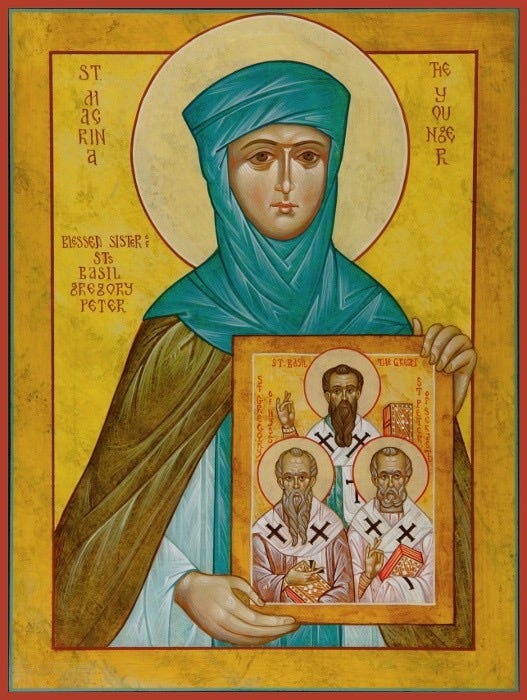
Gregory of Nyssa’s great work, On the Soul and the Resurrection, is an extended dialogue with his big sister, and, among other things, shows her clear belief in universal reconciliation. In chapter ten of On the Soul and the Resurrection, Gregory attributes to her these sayings:
“...when God brings our nature back to the first state of man by the resurrection, it would be pointless to mention such matters [as all the contextual details that led individuals to behave as badly or well as they did] and to suppose that the power of God is hindered from this goal by such obstructions. He has one goal: when the whole fullness of our nature has been perfected in each man, some straightway even in this life purified from evil, others healed hereafter through fire for the appropriate length of time, and others ignorant of the experience equally of good and of evil in the life here, God intends to set before everyone the participation of the good things in Him, which the Scripture says eye has not seen nor ear heard, nor thought attained. This is nothing else, according to my judgment, but to be in God Himself....”
also,
“...when our nature will have its tabernacle pitched again by the resurrection, and all the corruption which has entered in connection with evil will be abolished from the things that are, then the festival around God will be inaugurated in common for those who are covered by the resurrection, so that one and the same joy will be set before all. No longer will rational beings be divided by different degrees of participation in equal good things. Those who are now outside because of evil will eventually come inside the sanctuary of divine blessedness…”