
Xunzi on what is in our control
Sounding a very Epictetian note

I noticed that I’ve slipped into a few bad habits recently, relating both to my mental and my physical health, and I resolved this morning to try to make things better. The first step involved getting back into weight training after a couple weeks off, and a new discipline between sets: I’ve stacked a pile of some of my favorite works of practical philosophy, mostly Confucian and Stoic, on the table in the garage, and in between sets I read a few passages from one rather than scrolling on my phone.
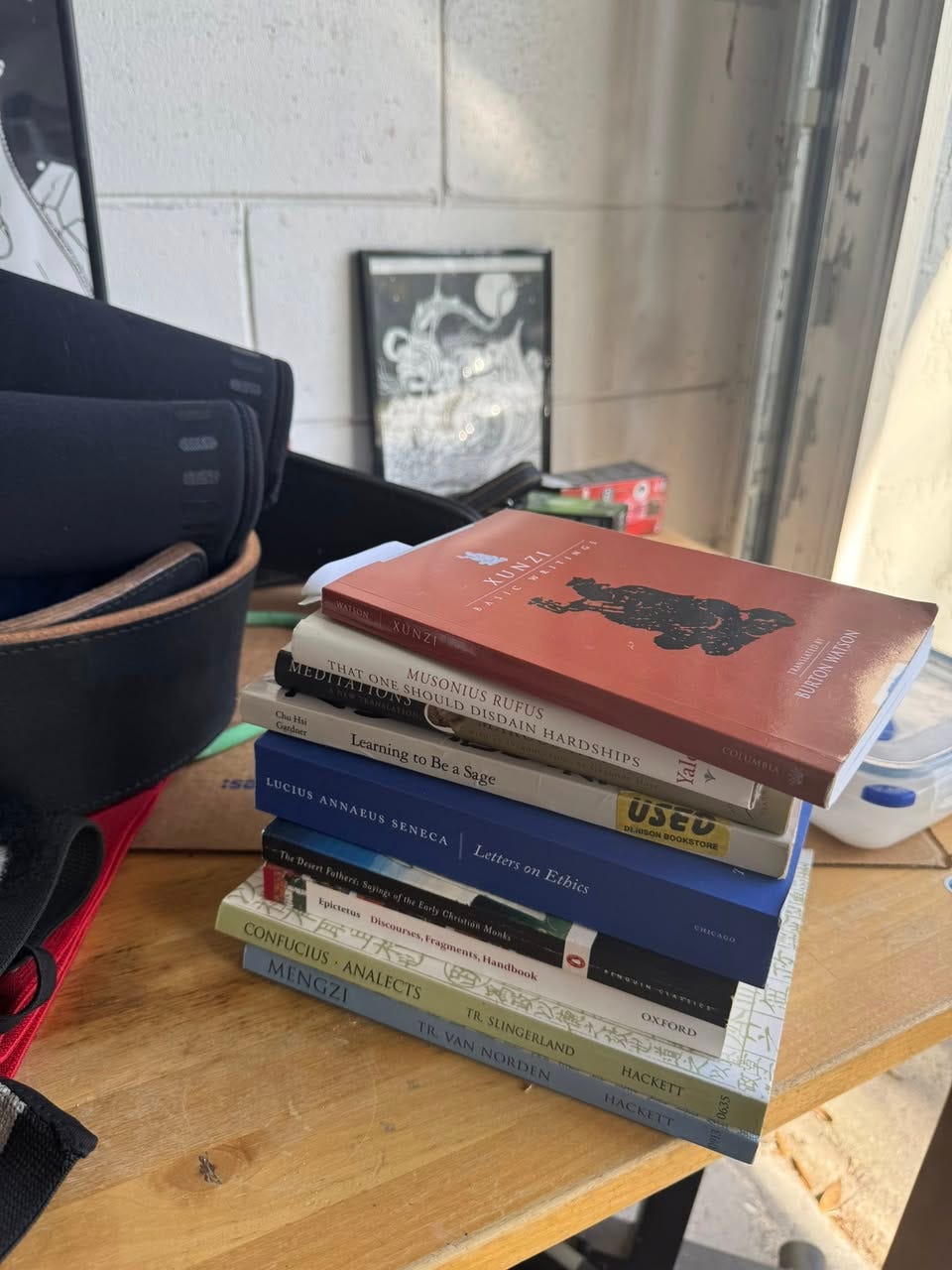
Today I came across a wonderful passage in the works of the early Confucian philosopher Xunzi:
“Heaven does not suspend the winter because men dislike cold; earth does not cease being wide because men dislike great distances; the virtuous person does not stop acting because petty men carp and clamor. Heaven has its constant way; earth has its constant dimensions; the virtuous person has his constant demeanor. The virtuous person follows what is constant; the petty person reckons up his achievements…
The king of Chu has a retinue of a thousand chariots, but not because he is wise. The virtuous person must sometimes eat only boiled greens and drink water, but not because he is stupid. These are accidents of circumstance. To be refined in purpose, rich in virtuous action, and clear in understanding; to live in the present and remember the past—these are things which are within your own power. Therefore the virtuous person cherishes what is within his power and does not long for what is within the power of Heaven alone…Because the virtuous person cherishes what is within his power and does not long for what is within Heaven’s power, he goes forward day by day.”
I was a bit surprised at just how Stoic this sounded. Epictetus, for example, famously locates the beginning of wisdom and happiness in distinguishing what is in our control and what is not. External events are in general not fully in our control, but our actions, and our re-actions, are. We cannot control what others think, our reputation, wealth, status, etc., but we can control our judgments, our choices, our inner life. And once we realize that goodness only truly attaches to things that we can control, then we realize that living a good life is always in our power, that no one can take it from us. Knowing this can provide a sage-like confidence and tranquility as we navigate life.
Xunzi, writing 300-400 years before Epictetus, sounds very similar notes here, denoting ‘Heaven’ as the source of what is not in our control, similar to the Stoics’ notion of Fate. The only way to ‘move forward day by day’ in life is to focus on what is in our power, and trust that ‘Heaven’ will take care of the rest. And I particularly like the list of things Xunzi picks out as in our control - to act virtuously, to set purpose for our life, to improve our understanding, and to live in the present.
These are things I need to hear often. I’ve noticed that the biggest trigger for frustration, depression, and temptation in my life is resentment at a lack of control, especially of my time. That I cannot rest when I want, read when I want, write when I want; that others constantly make demands that seem unfair. I need to realize that the things I want to accomplish are not actually my main goal in life, that my main goal in life is (or ought to be) to live well, to be virtuous. And doing this means precisely responding virtuously to those things that I cannot control and protecting the things I can.
This is perhaps an overly-self-indulgent post. Hopefully it can still impart or remind of wisdom. But in bringing up Confucianism, it is perhaps a nice warm-up for my next post, which will be on the Neo-Confucian spiritual practice of “quiet-sitting.” Until then.
Just what I needed to hear this morning. Thank you.
A great reflection, and I wouldn't call it self indulgent. I think it's what people need to hear sometimes, to sit still and be at peace with whatever is happening in our hearts and minds. I think it's almost necessary at times.